NetSuite Process Analytics: Turning Operational Data into Actionable Insights
Jul 13, 2026
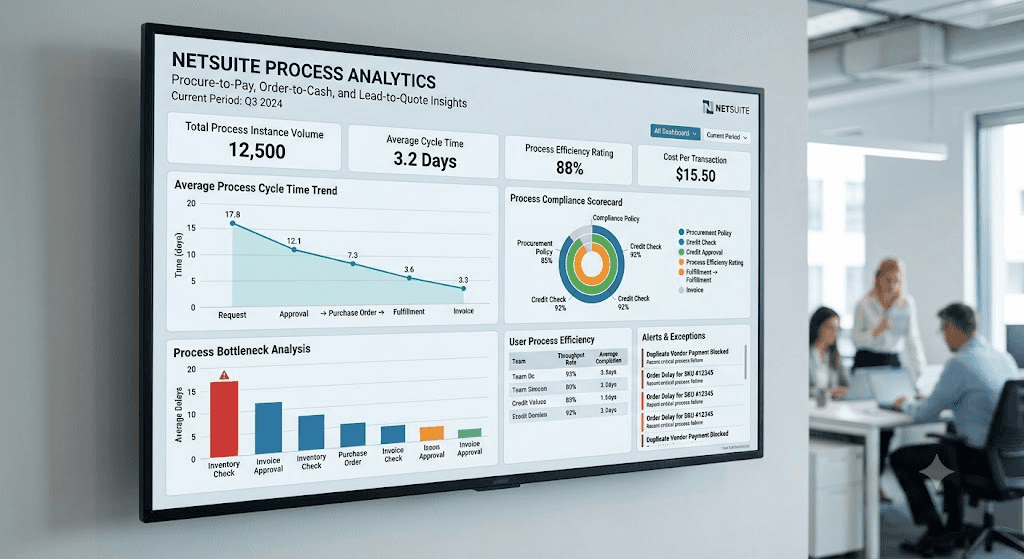
Organizations generate large volumes of operational data every day through activities such as purchasing, inventory management, sales, finance, manufacturing, and customer service. While standard reports summarize business results, they often provide limited visibility into how work actually moves through different business processes. NetSuite process analytics helps organizations examine operational data in greater detail, allowing them to understand process performance, identify inefficiencies, and support informed decision-making.
As businesses grow, workflows become increasingly complex. Additional approvals, changing customer requirements, new regulatory obligations, and expanding operations can introduce variations that affect efficiency. Process analytics enables organizations to evaluate these changes using real operational data rather than relying on assumptions or manually documented procedures.
What Is NetSuite Process Analytics?
NetSuite process analytics is the practice of examining business process data generated within NetSuite to understand how operational activities are performed. It combines transaction information, workflow events, timestamps, and process records to evaluate the efficiency and consistency of business operations.
Instead of focusing only on financial or operational outcomes, process analytics examines the steps that lead to those outcomes. This allows organizations to understand how transactions progress through different stages, where delays occur, and how process variations influence overall performance.
The objective is to improve visibility into business operations and support continuous process improvement through data-driven analysis.
Why Process Analytics Is Important
Business processes involve multiple departments working together. Sales teams create customer orders, procurement teams purchase materials, warehouse staff manage inventory, finance teams process transactions, and customer service representatives support clients throughout the order lifecycle.
Because these activities are interconnected, delays or inefficiencies in one area often affect other business functions. Process analytics helps organizations understand these relationships by analyzing actual workflow execution across departments.
This comprehensive view enables decision-makers to identify operational challenges before they significantly affect business performance.
Business Processes That Can Be Analyzed
Organizations use process analytics to evaluate a wide range of business activities within NetSuite.
Order-to-cash processes help analyze how customer orders move from order entry through fulfillment, invoicing, and payment collection.
Procure-to-pay workflows provide visibility into purchasing requests, supplier approvals, invoice processing, and payment cycles.
Inventory management processes reveal inventory movements, replenishment activities, warehouse transfers, and stock adjustments.
Manufacturing workflows support analysis of production scheduling, work orders, material consumption, and production completion.
Financial processes include journal entries, approval workflows, reconciliations, budgeting activities, and financial close procedures.
Key Insights Provided by Process Analytics
Process analytics provides valuable operational information that supports continuous improvement. Organizations commonly use it to identify:
Process bottlenecks that increase cycle times.
Workflow variations across departments or business units.
Repetitive manual activities that reduce efficiency.
Approval stages that delay transaction processing.
Process exceptions that occur frequently.
Opportunities to standardize business operations.
These insights help organizations better understand process performance while supporting evidence-based operational decisions.
Improving Operational Visibility
Traditional reporting often summarizes completed transactions without explaining the sequence of operational events behind them. Process analytics addresses this limitation by providing greater visibility into workflow execution.
Managers can monitor processing times, evaluate resource utilization, compare workflow paths, and identify activities that contribute to operational delays.
This visibility enables organizations to understand how different business functions interact and where operational improvements may have the greatest impact.
Supporting Data-Driven Decision-Making
Reliable business decisions require accurate information. Process analytics provides measurable evidence about operational performance instead of relying solely on assumptions or anecdotal observations.
Historical process data allows organizations to compare workflow performance over different time periods, evaluate the effectiveness of operational changes, and prioritize improvement initiatives based on objective findings.
Decision-makers can also monitor key operational indicators that support planning, resource allocation, and business strategy.
Continuous Process Improvement
Business processes evolve over time as organizations introduce new technologies, expand operations, or respond to changing customer expectations. Continuous monitoring ensures that workflows remain efficient as these changes occur.
Regular process analysis enables organizations to identify emerging bottlenecks, monitor operational consistency, and evaluate whether process improvements have achieved their intended results.
Rather than treating process optimization as a one-time project, organizations can establish an ongoing cycle of measurement, analysis, and improvement.
Conclusion
NetSuite process analytics provides organizations with a deeper understanding of how business processes operate by examining operational data generated throughout daily activities. By analyzing workflows instead of only reviewing final business results, organizations gain greater visibility into process performance, identify opportunities for improvement, and support more informed decision-making. As operational complexity continues to increase, process analytics offers a practical approach for improving efficiency, enhancing transparency, and driving continuous business improvement through reliable data analysis.
Frequently Asked Questions
1. What is NetSuite process analytics?
NetSuite process analytics is the analysis of operational data generated within NetSuite to evaluate how business processes are executed, identify inefficiencies, monitor workflow performance, and support data-driven decision-making.
2. How is process analytics different from traditional reporting?
Traditional reports summarize business results, while process analytics examines the sequence of operational activities that produce those results, providing greater visibility into workflow performance and process execution.
3. Which business processes can be evaluated using process analytics?
Organizations commonly analyze order-to-cash, procure-to-pay, inventory management, manufacturing, financial close, procurement, approval workflows, and customer service processes.
4. What data is used in NetSuite process analytics?
Process analytics uses transaction records, workflow events, timestamps, approval histories, user activities, and operational event data generated within NetSuite.
5. Why is process analytics important for organizations?
Process analytics helps organizations identify bottlenecks, improve operational visibility, measure workflow performance, support continuous improvement, and make business decisions based on objective operational data.